Eye-Tracking Technology in New Cars: How Does It Work?
How Eye-Tracking Technology Is Being Used in New Cars If [...]
Jump to Section:
How Eye-Tracking Technology Is Being Used in New Cars
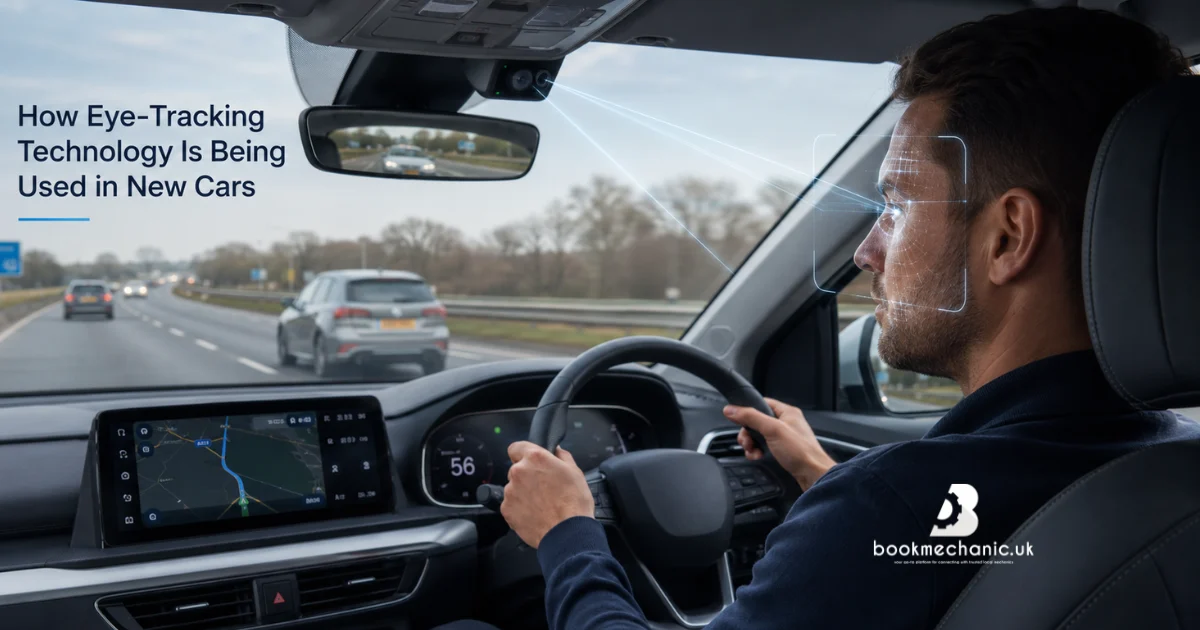
If you have recently sat inside a new car, you may have noticed a small camera near the rear-view mirror, instrument display or steering column.
It can look like part of the vehicle’s alarm system, but in many newer cars it has a different purpose: it is watching the driver.
Eye-tracking technology can monitor where the driver is looking, whether their eyes are beginning to close and how long their attention has moved away from the road. If the system believes the driver is tired, distracted or no longer responding, it can produce a warning.
That may sound slightly intrusive, but the purpose is straightforward. The system is intended to recognise a dangerous loss of concentration before it leads to a collision.
Is this really “laser eye” technology?
Some reports have described the systems as laser eye technology. That makes for an eye-catching headline, but it is not usually the most accurate explanation.
Most eye-tracking technology fitted to modern vehicles uses an inward-facing camera with infrared illumination. The infrared light is invisible to the driver and helps the camera identify features such as the eyes, pupils, eyelids and position of the face.
The camera captures reflections from the surface of the eye. Software then uses these reflections, along with the position of the head and face, to estimate where the driver is looking.
This means the vehicle may be able to recognise whether the driver is:
- looking ahead at the road
- checking the mirrors
- looking down at a phone
- using the infotainment screen
- turning towards a passenger
- repeatedly closing their eyes
- beginning to fall asleep
A technical explanation from driver-monitoring developer Smart Eye describes how infrared light, eye reflections and camera-based tracking are used to detect driver distraction and drowsiness.
This should not be confused with LiDAR. LiDAR uses laser pulses to examine the area outside a vehicle, measuring the distance between the car and surrounding objects. Driver monitoring looks inside the vehicle at the person behind the wheel.
What does the system actually monitor?
The capability of eye-tracking technology varies between manufacturers and vehicle models.
Some systems simply look for signs of tiredness. Others continuously monitor eye movement, head position and the direction of the driver’s gaze.
A modern driver-monitoring system may analyse:
- how open or closed the driver’s eyes are
- blinking patterns
- where the driver is looking
- how long the driver looks away
- head movement and position
- posture and upper-body movement
- repeated signs of distraction
- signs of drowsiness
- whether the driver is responding to warnings
Systems may also use information from other parts of the vehicle. Steering movements, lane position, journey duration and driving behaviour can all help the car decide whether the driver’s concentration is deteriorating.
There are two closely related types of technology.
Drowsiness and attention warning
Drowsiness and attention warning systems are designed to recognise when a driver may be becoming tired.
Early versions did not necessarily watch the driver directly. Instead, they looked at the way the car was being driven.
For example, the vehicle might notice:
- inconsistent steering corrections
- gradual movement within the lane
- an unusually long journey without a break
- changes in the driver’s normal behaviour
The car could then display a coffee-cup symbol or recommend taking a break.
Camera-based systems can go further by looking for physical signs of tiredness. These may include prolonged blinking, drooping eyelids, repeated eye closure or changes in the position of the driver’s head.
Advanced driver-distraction warning
Advanced driver-distraction warning is intended to recognise when the driver’s visual attention has moved away from the road.
Rather than waiting for the car to drift in its lane, the system may be able to see that the driver is looking down or towards another part of the cabin.
The Department for Transport describes advanced distraction warning as technology that alerts the driver when visual distraction is detected. This may include distraction caused by an activity competing for the driver’s attention, such as inappropriate smartphone use.
A quick glance at a mirror or instrument display should not normally trigger an alert. The system looks at factors such as how long the driver looks away, where they are looking and what is happening around the vehicle.
What happens when the car detects distraction?
The first response is normally a warning rather than physical intervention.
Depending on the vehicle, this could be:
- a message on the instrument display
- a warning symbol
- an audible chime
- steering-wheel vibration
- seat vibration
- a spoken instruction
- a recommendation to stop and take a break
If the driver continues to look away, the warning may become more noticeable or repeat more frequently.
Some vehicles combine driver monitoring with adaptive cruise control, lane assistance and emergency safety systems. The vehicle can use information about the driver’s attention to adjust how those systems respond.
For example, assistance may become more cautious if the car believes the driver is not fully engaged.
On some advanced vehicles, the system may be capable of slowing down and bringing the car to a controlled stop if the driver becomes completely unresponsive. That is not a feature on every vehicle, but it is an area being recognised in current vehicle-safety testing.
From 2026, Euro NCAP’s driver-monitoring assessments place greater emphasis on continuous eye and head tracking, system reliability and whether a vehicle can respond safely when a driver becomes unresponsive.
Why is eye-tracking technology appearing now?
Eye-tracking technology has already been used in certain premium cars and vehicles with advanced motorway-assistance systems for several years.
The difference now is that driver monitoring is moving into ordinary family cars and vans.
Part of the reason is new vehicle-safety regulation.
Under the EU General Safety Regulation, advanced driver-distraction warning requirements applied to newly approved vehicle types from July 2024 and to all relevant newly registered vehicles from 7 July 2026.
These requirements form part of a wider package of safety equipment that includes technologies such as:
- autonomous emergency braking
- intelligent speed assistance
- reversing detection
- emergency lane keeping
- tyre-pressure monitoring
- event data recorders
- drowsiness and attention warnings
- advanced distraction warnings
The EU requirements also apply in Northern Ireland through the Windsor Framework. Great Britain has its own vehicle type-approval system, so the position in England, Scotland and Wales has developed separately.
What is happening in Great Britain?
The UK government held a consultation during 2026 about requiring 18 vehicle-safety technologies under the Great Britain type-approval system.
The consultation closed in May 2026. In its response, published on 16 July 2026, the government confirmed that it intends to proceed with the full package of 18 technologies for mass-produced vehicles.
The package includes:
- advanced distraction warning
- drowsiness and attention warning
- emergency braking
- reversing motion awareness
- blind-spot information
- tyre-pressure monitoring
- emergency lane keeping
- intelligent speed assistance
You can read the full UK government response on vehicle-safety technology on GOV.UK.
The government has confirmed the policy direction, but the Great Britain implementation dates are connected to when the necessary legislation enters into force.
Under the current plan:
- newly approved GB vehicle types would need to comply 12 months after the legislation enters into force
- newly registered complete vehicles would generally need to comply 24 months after entry into force
- some categories and vehicle-conversion arrangements would receive longer implementation periods
This means it would be misleading to say that driver monitoring is already legally required on every new car registered in Great Britain.
However, many vehicles sold here may already include it. Manufacturers regularly build cars to a broadly shared European specification rather than producing an entirely separate version for Great Britain.
Does the camera record the driver?
This is understandably one of the biggest concerns.
Finding out that your car contains an inward-facing camera can create the impression that every journey is being filmed and stored.
That is not generally how a legally required driver-distraction system is intended to operate.
In most cases, eye-tracking technology assesses the driver’s face and attention in real time. The software uses the information to decide whether a warning is needed.
The EU General Safety Regulation states that drowsiness and advanced distraction-warning systems should not continuously record or retain information beyond what is needed for the system’s purpose. It also says that the information should not be made available to third parties and should be deleted after processing.
However, vehicle systems vary.
A connected car may contain several different cameras, processors and online services. The driver-monitoring camera may operate separately from a dash camera, security camera, emergency system or vehicle app.
Owners concerned about privacy should check:
- the vehicle handbook
- the manufacturer’s privacy notice
- the connected-services settings
- the vehicle’s mobile application
- whether any data-sharing options are enabled
A driver-monitoring camera should not automatically be treated as a cabin-recording dash camera. Although the hardware can look similar, the purpose may be completely different.
Will it work with glasses and sunglasses?
Modern eye-tracking technology is designed to work in a wide range of lighting conditions and with drivers of different appearances.
Infrared imaging helps the camera detect facial and eye features at night or when cabin lighting changes.
Systems are also developed to work with:
- prescription glasses
- sunglasses
- hats
- facial hair
- face coverings
- different seating positions
Driver-monitoring technology developer Seeing Machines says its systems analyse head position, eyelid movement and gaze across demanding lighting conditions, including when sunglasses are being worn.
That does not mean every system will work perfectly in every situation.
Very dark lenses, reflected sunlight, an unusual driving position or an obstructed camera can affect performance. A dashboard-mounted phone holder, air freshener or aftermarket accessory could also block the camera’s view.
Why do drivers sometimes find the warnings annoying?
The difficult part is finding the right balance.
A warning must react early enough to be useful, but not so frequently that the driver begins ignoring it.
False or unnecessary warnings may occur when a driver is:
- checking a junction
- looking through a bend
- using the mirrors
- checking the speedometer
- adjusting the heater
- using the manufacturer’s own touchscreen
- wearing certain sunglasses
- sitting outside the camera’s ideal field of view
If a system repeatedly produces unnecessary warnings, the driver may lose confidence in it or try to switch it off.
This issue was raised during the UK government’s 2026 consultation. Respondents highlighted concerns about inaccurate detection, unnecessary intervention and warnings that could cause distraction or encourage drivers to deactivate the system.
Euro NCAP’s newer assessment approach therefore looks at system reliability and user acceptance, not simply whether a camera is fitted.
Can the system be switched off?
This depends on the manufacturer and the vehicle.
Some cars allow certain warnings to be muted or adjusted through the driver-assistance settings. Others automatically reactivate the feature whenever the vehicle is restarted.
Driver monitoring may also be connected to other systems. Disabling it could affect the operation of motorway assistance, adaptive cruise control or lane-keeping functions.
Owners should consult the handbook before changing any settings.
It is also important to remember that switching off a warning does not remove the risk it is intended to address. If you are tired enough for the system to keep producing alerts, the correct response is to stop somewhere safe and take a proper break.
The driver is still responsible
Driver monitoring does not turn an ordinary car into a self-driving vehicle.
Lane assistance, adaptive cruise control and motorway assistance can reduce the driver’s workload, but the person behind the wheel must remain alert and ready to take control.
Rule 150 of The Highway Code says drivers must maintain proper control of their vehicle and should not reduce their concentration because assistance systems are active.
The system is there to support the driver, not replace them.
What if the system develops a fault?
As driver-monitoring equipment becomes more common, garages and independent mechanics will see more faults connected with it.
The camera or sensor may be positioned:
- beside the rear-view mirror
- within the roof console
- on the steering column
- above the instrument display
- inside the dashboard
- behind the infotainment screen
- on an interior pillar
A warning could be caused by something as simple as dirt or an object blocking the camera.
Other possible causes include:
- damaged wiring
- a faulty camera module
- a software problem
- low vehicle voltage
- communication faults between control modules
- incorrect camera alignment
- replacement of a related component
- an interrupted software update
Work involving the windscreen, dashboard, rear-view mirror or steering column may affect the system.
Depending on the vehicle, replacement components could require coding, calibration or software configuration before the warning disappears.
The UK government consultation also highlighted the importance of making sure these safety systems remain properly maintained, repaired and calibrated throughout the life of the vehicle. Respondents specifically raised the need for independent repairers to have access to suitable technical information, diagnostic equipment, software and training.
If a driver-monitoring warning remains illuminated, first check that the camera is clean and unobstructed. If the fault remains, it should be diagnosed rather than ignored or covered.
What should used-car buyers check?
Driver-monitoring equipment is another item worth checking when buying a newer used vehicle.
During a viewing or test drive:
- Look for driver-monitoring or assistance-system warning lights.
- Check for damage around the mirror, steering column and instrument panel.
- Make sure no accessories are blocking the camera.
- Confirm that warning lights go out normally after starting.
- Ask whether the windscreen or mirror assembly has been replaced.
- Test the driver-assistance settings where it is safe to do so.
- Check the handbook to understand how the system should behave.
- Ask whether any software updates or calibration work are outstanding.
A car may still drive normally with a driver-monitoring fault, but part of its safety equipment may not be working correctly.
The fault could also affect other connected driver-assistance functions.
Is the technology a good idea?
There are reasonable questions about privacy, accuracy and whether modern cars already produce too many warnings.
Those concerns should not be dismissed.
A poorly calibrated system that regularly interrupts an attentive driver can be frustrating. It may even encourage the owner to disable a feature that could otherwise be useful.
However, the basic principle makes sense.
Distraction can happen quickly. A driver may look at a message, become tired during a motorway journey or place too much trust in adaptive cruise control. A warning at the right moment could be enough to bring their attention back to the road.
The system does not need to take control of the vehicle to make a difference. Sometimes, a warning chime and a message telling the driver to look ahead may be all that is required.
As eye-tracking technology moves from expensive vehicles into everyday cars and vans, drivers and repairers will need to understand what the cameras do, how the warnings behave and what happens when the system develops a fault.
It is another example of vehicle safety moving beyond mechanical components. Brakes, tyres and suspension remain essential, but modern garages must now also understand cameras, software, control modules and calibration.
Find a local mechanic through BookMechanic.uk
If your vehicle has displayed a driver-monitoring or driver-assistance warning, BookMechanic.uk can help you find independent mechanics and garages offering diagnostics, servicing and repairs.
Search local providers, view their business profiles and send an enquiry or booking request online.
Visit BookMechanic.uk: Bookmechanic.uk

Author: bookmechanic.uk
 Welcome Express Tyres and Auto Ltd - Ossett
Related Posts






Popular Locations